

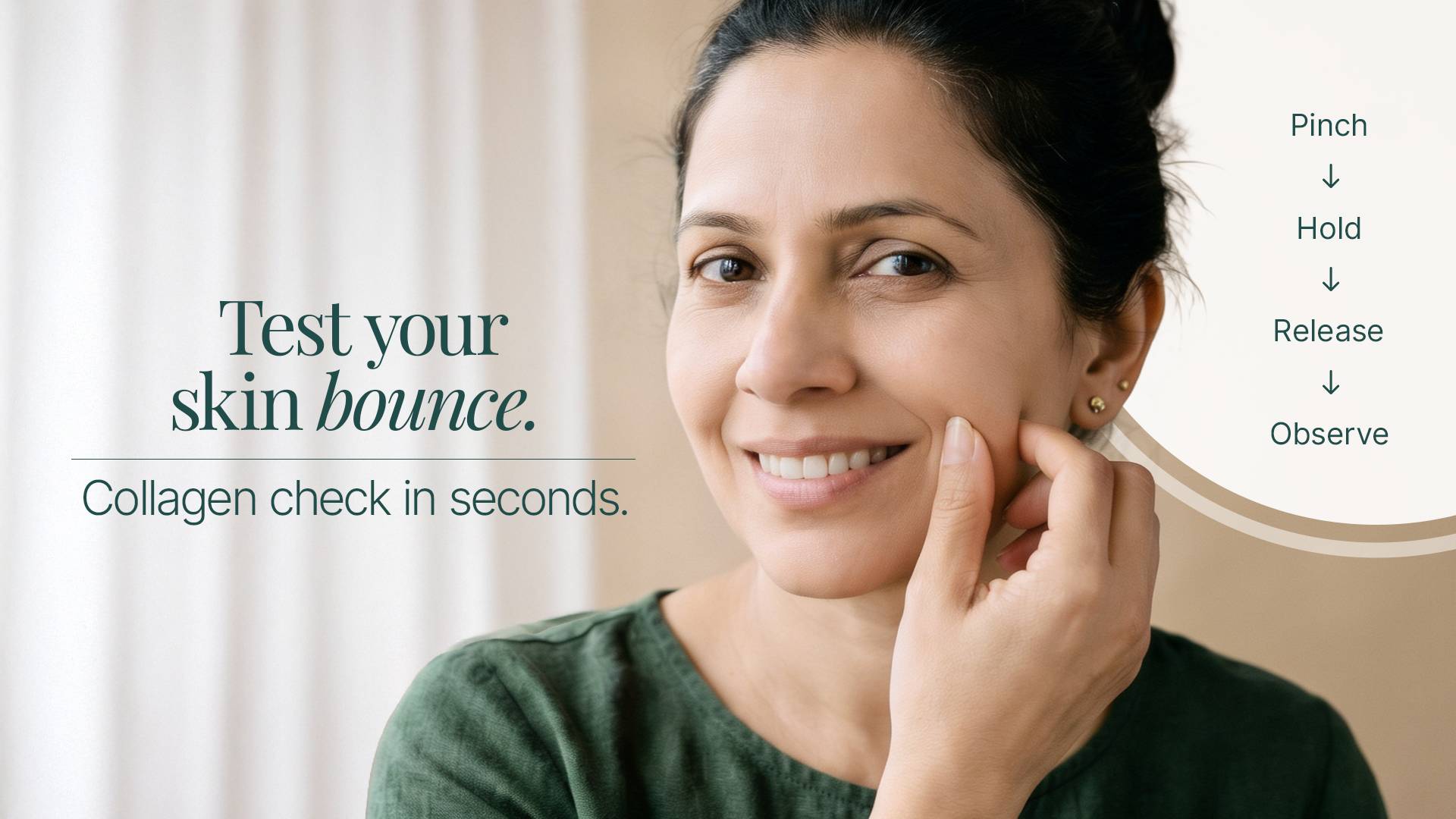
Most of us rely on visible changes to determine our skin health. From fine lines and wrinkles to dullness, everything has something to tell. However, we often overlook how our skin behaves, especially when it is stretched. This is where the pinch test gained attention. This quick at-home check claims to reveal insights about your skin’s true age. It assesses elasticity, a key indicator of collagen strength. But how well can a simple pinch test perform? Is there more to the story? Here is what you need to know.
What Is The Pinch Test?
The pinch test is a simple method that determines your skin’s age and elasticity. It tells your skin’s ability to stretch and snap back to its original form. You can perform it on your cheeks, jawline, or back of your hand. To do it:
- Gently pinch a small area of your skin
- Hold it in place for 5-10 seconds
- Release and observe how long it takes to regain the original state
The logic behind this test is simple. While a faster rebound rate indicates better elasticity and resilient skin, a slower rate hints at reduced elasticity.
How To Interpret Your Results
Skin behavior is influenced by factors like hydration, thickness, lifestyle, and other factors. This makes the pinch test good for reference, and not a precise diagnostic method.
| Time Taken (in seconds) | Age (in years) |
| 1-2 | Under 30 |
| 3-4 | 30-44 |
| 5.9 | 45-50 |
| 10-15 | 60 |
| 35-55 | 70 |
| 56 or more | Over 70 |
What The Pinch Test Measures
The outcome of this test highlights three primary aspects:
- Collagen Levels
Collagen is a naturally occurring protein that acts as your skin’s support system. It is present in dense fibre networks to help your skin maintain its shape, firmness, and strength. Research shows that as we age, our bodies start producing about 1% less collagen every year. And this decline makes your skin lose its strength by degrading existing fibres. - Elastin
Elastin gives your skin that springy effect to retain the original shape. Found in the dermis layer, elastin works in partnership with collagen and focuses on flexibility. Factors like age and exposure to environmental stressors can cause elastin to degrade and make your skin look saggy. - Hydration Levels
Hydration can also impact your skin’s response to being stretched, pulled, or pressed. Well-hydrated skin tends to bounce back faster and look glowy and radiant. But when your skin is hydrated properly, it becomes easier to retain moisture for long and look supple.
Limitations Of Pinch Test
Despite its wide popularity, the pinch test has some limitations. Here are a few factors that can affect your results:
- Hydration levels at the time of testing
- Area of the skin tested
- Genetics
- Skin thickness
- Environmental conditions
What Research Says About Skin Elasticity
Skin elasticity is not a surface level characteristic, but a result of an internal structure. Research shows that fibroblasts, a type of cell, play a crucial role in this process. They produce collagen (types I ad III), elastic, and ground substances to form the foundation of your skin.
Similarly, collagen forms dense fibre bundles to support your skin under stress. It helps your skin obtain the original form after being stretched through a recoil system. And this coordinated response is called viscoelasticity.
But as you age, factors like prolonged sun exposure weaken this collagen structure. Similarly, elastin fails to function properly and makes your skin slow to bounce back. And this is exactly what the pinch test aims to reflect.
How To Improve Pinch Test Results
If your skin takes longer to return to its original shape, don’t worry. While it’s a natural part of ageing, certain lifestyle habits can help build skin resilience.
- Use sunscreen- Use sunscreen with SPF 30 or higher to prevent sun damage. Opt for broad-spectrum formulas to fight UVA and UVB rays and prevent premature
aging and photoageing. - Quit smoking and alcohol- If you smoke or consume alcohol regularly, it is high time to quit these habits. It can prevent skin dehydration and toxins from damaging your body.
- Use moisturiser- Always use a hydrating moisturiser for your face and bod. Choose ingredients based on your skin type to reduce transepidermal water loss (TWEL). For instance, while shea butter and glycerin are ideal for dry skin, oily skin can benefit from hyaluronic acid and green tea extract.
- Reduce sugar intake- Consuming excess sugar can damage collagen through glycation. It involves sugar molecules attaching to proteins and lipids to form AGEs
or Advanced Glycation End Products. - Use retinol and retinoids- For people with less skin elasticity, retinol and retinoids can do wonders. Some studies found that retinol can increase cell production,
boost collagen, and reduce the appearance of fine lines and wrinkles. - Eat antioxidant-rich diet- Antioxidants shield the body from oxidative stress. They can prevent photodamage of the skin and ageing. Eating foods like acai berry, cashew nuts, etc can strengthen your skin’s built-in defence system against stressors.
The pinch test is a simple tool to gain a sneak peek into your skin’s functioning. Although it may not be 100% accurate, this test can still reflect collagen, hydration, elastin, and other factors. So, instead of focusing on the number, use it as a motivational boost to improve habits and take the right steps.
Frequently Asked Questions (FAQs)
The pinch test can give a rough estimate of your skin’s age, elastin, hydration, and other things. It is not an exact measure, but an indicative tool.
You can perform the pinch test on your cheeks, jawline, and the back of your hand.
Hydration, skin thickness, and genetics can affect the results of your pinch test.
Generally, skin starts losing elasticity in the late 20s. This is when ageing, UV damage, and other stressors reduce collagen and elastin production.
Sun protection, proper hydration, antioxidant-rich diet, and consistent skincare can improve skin elasticity.
Keywords : Pinch Test on Skin, Skin True Age, Skin Health Check, Skin Ageing, Skin Hydration