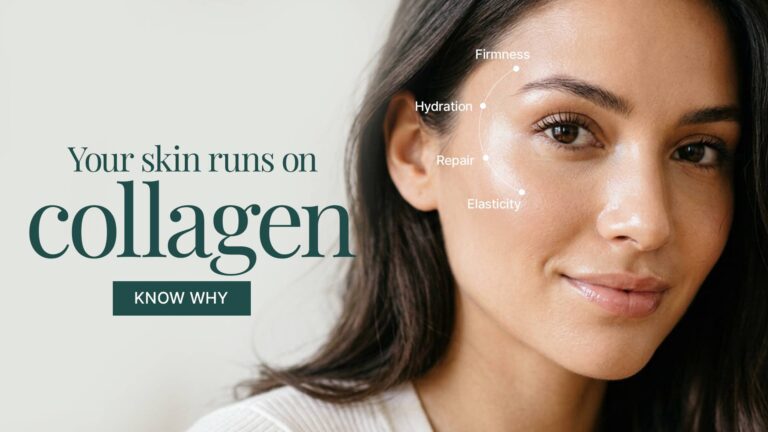

If your skin looks firm, smooth and youthful, its time you know its all because of single protein, Collagen! It is not just a skincare buzzword, it is the literal foundational structural protein that are made of amino acids. Collagen is a structural protein and the most abundant one that is around 30% of all protein in the human body.
Collagen molecules have a distinctive triple-helix structure that are made from amino acids — primarily glycine, proline, and hydroxyproline. The molecule of the collagen is coiled shape which is responsible for its extraordinary tensile strength which helps giving tissues their shape, strength, and flexibility. In simple words, its the concrete of your skin.
Where You can Find Collagen?
Collagen is produced deep within the 2nd layer of the skin, dermis by specialised cells known as fibroblasts. This protein is found in the skin, bones, ligaments, blood vessels, tendons, cartilage, eyes and teeth. Whatever you see in the mirror is nothing but the architect of collagen. There are 28 types of collagen, but when it comes to skin health, three types of collagen stand out the most.
Type 1: Abundant and Also The Skin Architect
Type 1 is found in abundance in the body. It provides tensile strength to skin, bones and tendons. This is the collagen that help maintain firm skin and is also prevents early wrinkles.
Type 2: Cushion for Joints
Type 2 is mainly found in cartilage. It is not directly involved in the skin but is still essential for tissue health and mobility.
Type 3: Responsible for Skin’s Elasticity
Type 3 collagen is the elasticity partner that works alongside Type I collagen for skin elasticity. So if your skin looks plump, supple and youthful its because of this collagen. The other side of this type of collage is that it also depletes with age alongside Type I and hence results in ageing signs.
Why your skin depends on collagen
Collagen ain’t just the skincare gimmick, to actually understand collagen’s role in skin health, you need to understand the three layers of the skin.
- The epidermis: It is what you see, the outermost layer.
- The Dermis: Located below the epidermis you can find a thick layer of connective tissue where collagen molecules and elastin fibres reside.
- The Hypodermis: It the the third layer of the skin that is made of fat and connective tissue.
Now that you’ve a good idea about collagen and layers of the skin, lets understand the actual dependency of skin on collagen,
- Collagen is responsible to provide structural support: Collagen fibres combine to form a dense mesh that helps maintain firmness of the skin. In simple words, when the mesh is intact and dense, the skin looks more plump and youthful.
- Collagen helps maintain moisture retention: Collagen binds with glycosaminoglycans (mainly hyaluronic acid) tat helps the skin hold water and therefore keeps it smooth and hydrated.
- Collagen helps in skin repair: Collagen is deployed as one of the first materials to close the wound when the skin gets injured. Collagen facilitates rebuilding of damaged tissues and skin cells.
- Collagen ensures skin elasticity: Collagen and elastin fibres, combine to ensure skin elasticity where it can stretch and then snap back to its original form.
- Collagen help protects underlying structures: The collagen framework located in the dermis acts as a protective layer for blood vessels, nerves, and glands situated beneath the skin surface.
What skin looks like: When collagen is abundant vs. When collagen is depleted
Collagen production begins from the birth and is found to be abundant during adolescence and early adulthood. During this period collagen levels are healthy due to which skin appears firm, supple, smooth and bouncy, glows naturally. You can barely see ant fine lines or witness early signs of ageing.
But when you cross 20 every year collagen level drops by 1% and collagen begins to degrade. Not just by age, there are various others factors which can lead to depletion of collagen levels – like sun exposure, or lifestyle. The dermis layer of the skin becomes thinner and therefore the weak collagen framework results in structural changes of tissues like – skin loses elasticity, becomes dehydrated, develops wrinkles, and gradually begins to sag. Women can lose up to 30% of their skin collagen in the first five years alone of menopause — that major factor is sudden drop in oestrogen levels which also plays a vital roles in collagen synthesis.
Now that we know the importance of collagen and its vitality for skin health it becomes very necessary to support collagen production naturally with the help of right nutrient support. It also becomes very crucial to follow proper skincare regime backed with suitable ingredients for an extra external support to maintain healthy and youthful-looking skin.
Keywords : What is Collagen, Types of Collagen, Collagen helps in skin repair, Youthful skin, Skin dependency on Collagen