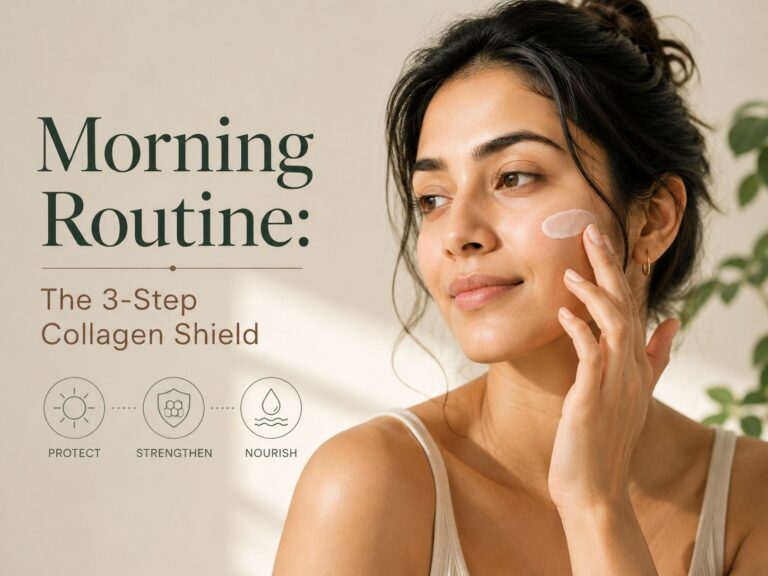

Ingredients play an important role in skincare. Some work individually, while some work in pairs. Vitamin C and collagen are one of those pairs. When working together, these deliver magical results for the skin. Separately, both Vitamin C and Collagen are already heavy hitters. Vitamin C is rich in antioxidant properties and is one of the best-researched ingredients in dermatology. Vitamin C is known for its protective, brightening and collagen-boosting abilities. On the other hand, Collagen is the structural protein that holds your skin together. Collagen provides your skin with its elasticity, firmness, and density, helping you look youthful, which later starts to fade with age.
When it comes to skincare, either of the two is often taken for granted. People don’t realise: Vitamin C and collagen don’t just complement each other — they also depend on each other. When it comes to collagen boosting, Vitamin C is not optional. It is a mandatory pairing because, without it, your body cannot adequately stimulate collagen production. And without ample collagen, your skin will lose its radiance, texture and overall structure. Therefore, Vitamin C and collagen are the ultimate power couple. Their partnership boosts radiance, fights ageing, and rebuilds your skin, making you look youthful and radiant.
In the article below, you’ll understand the biological relationship of the two ingredients — their biology, the way to strengthen it further, mistakes that you need to avoid and a skincare regimen that can actually transform your skin.
What Is Collagen — And Why Does It Deplete With Age?
Collagen is the most abundant structural protein in the human body. Collagen forms a dense, fibrous network in the dermis that provides the skin with its structure, elasticity, thickness, and resilience.
Your skin’s collagen works much like a mattress’s. When the mattress is new, the coils hold the mattress’s shape tightly, maintaining its optimal bounce. But over time, those coils lose their rebound. When skin has ample collagen, it looks radiant, bouncy and younger. But when skin loses collagen, it starts to show signs of ageing, dullness and loss of structure.
Age alone is not the culprit; it’s the combination of several factors that accelerate collagen breakdown:
- Natural ageing: After your mid-20s, collagen production starts depleting by at 1% per year. By the age of 50, you’ve almost lost 30% of your skin’s collagen density.
- UV exposure: This is the main culprit when it comes to premature skin ageing. Enzymes known as matrix metalloproteinases (MMPs) are triggered by exposure to ultraviolet radiation, which further actively degrades collagen fibres.
- Oxidative stress: Stimulation of collagen molecules gets hampered by free radical factors like pollution, processed foods, cigarette smoke and chronic stress. Not just that, it also slows the collagen production of new molecules.
- High sugar intake: High sugar intake will cause glycation. A process in which sugar molecules bind to collagen fibres, and make them stiff and dysfunctional. Most likely, it’s called “sugar sag.”
- Hormonal shifts: A dramatic drop in estrogen levels can be a major cause of collagen synthesis. This drop is usually observed during menopause, where skin loses up to 30% of its collagen in the first five years. This pace is usually faster than normal ageing.
All the above-listed concerns are gradual causes of collagen erosion, which makes skin rebuilding a little concerning. To deal with the challenging aspect of collagen production is where vitamin C becomes indispensable.
What Vitamin C Actually Does in Your Skin
Vitamin C, or L-ascorbic acid (chemical name), is a water-soluble vitamin that the human body cannot produce on its own. It must come from diet or topical application. And when it comes to skin, its purpose is often found to be miraculous, longer than most people realise.
Vitamin C has antioxidant properties that effectively neutralise free radicals generated by pollution, UV exposure, and oxidative stress. — Before they can damage collagen fibres, DNA, and cell membranes. Vitamin C acts as a defensive shield for the skin and helps prevent damage before it shows visible signs of ageing, such as wrinkles and fine lines.
Not just an antioxidant, Vitamin C is also a cofactor in collagen synthesis. This is where their chemistry gets the title of “Power Couple”. Collagen synthesis cannot happen on its own or on demand. The process needs to be triggered by certain enzymatic reactions. Two of the most critical enzymes — prolyl hydroxylase and lysyl hydroxylase — and vitamin C need to work hand in hand for adequate collagen synthesis. Without adequate vitamin C, these enzymes can’t function, resulting in rapid collagen breakdown.
Vitamin C also inhibits melanin production, which makes it one of the most evidence-backed brightening ingredients. It helps reduce dark spots, hyperpigmentation, and post-inflammatory marks over time.
It does not end here. Vitamin C also regenerates other antioxidants, particularly vitamin E. It helps to extend the skin’s overall antioxidant defence mechanism far beyond what any single ingredient could provide.
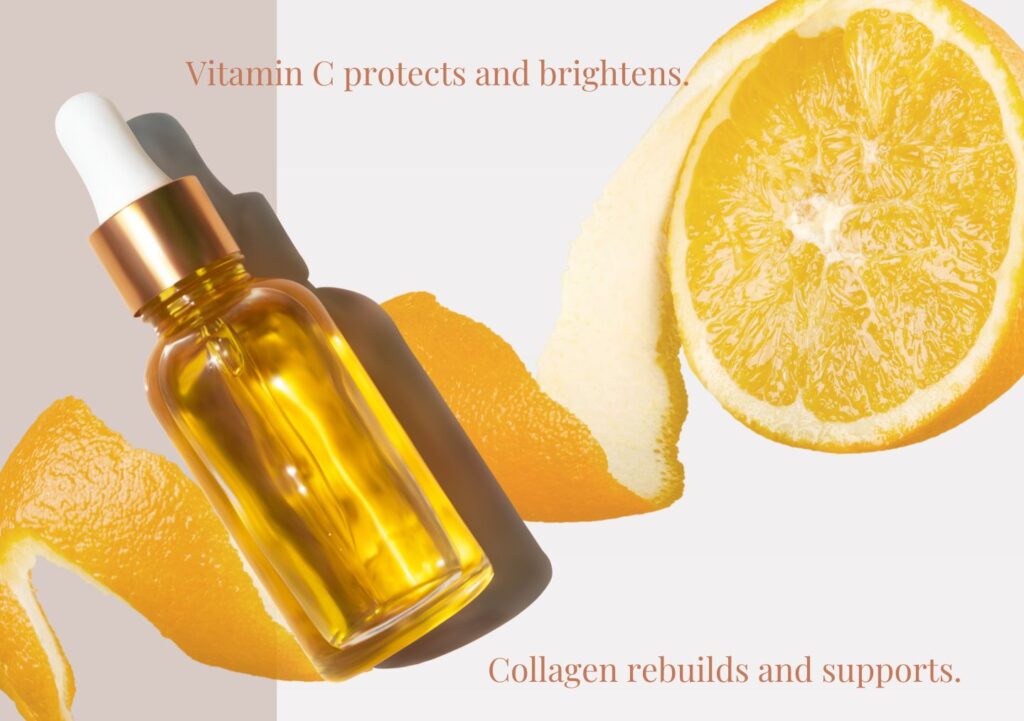
The Biological Partnership: How Vitamin C and Collagen Work Together
What makes this pairing so powerful has nothing to do with a marketing gimmick. In fact, the fundamental truth — Your skin cannot synthesise functional collagen without vitamin C. Period.
It’s all biochemistry. The triple helix structure of collagen forms only when amino acids such as hydroxyproline and hydroxylysine are present in the right proportions. Hydroxylase enzymes are required to produce these modified amino acids. And these hydroxylase enzymes need vitamin C to function.
The Vitamin C-Collagen partnership extends beyond collagen synthesis. Vitamin C’s antioxidant activity also shields the existing collagen from free radical damage. Thus, to maintain collagen integrity over time, Vitamin C seems a non-negotiable part of skin and skincare.
Topical vs. Oral: How Should You Get Your Vitamin C and Collagen?
We’re sure most of us think that having enough oranges and lemon juice is adequate for Vitamin C. But that’s where the real catch lies. Let’s dive into the practical conversation — and a little more nuanced.
Topical Vitamin C
When applied to the skin, Vitamin C in the form of L-ascorbic acid (the most bioavailable and well-studied form) is quickly absorbed into the epidermis and dermis. There, it neutralises free radicals, inhibits melanin synthesis and stimulates collagen production through its cofactor role.
The key variables for topical vitamin C efficacy are:
Concentration: Opt for a Vitamin C concentration of 10–20% for optimal brightening and antioxidant benefits. Above 20% can irritate your skin.
pH: L-ascorbic acid penetrates into the skin barrier with a low pH (around 2.5–3.5).
Stability: Vitamin C oxidises and loses its efficacy when exposed to direct light, air, or heat — it first turns yellow, then orange, and then brown, with the most degradation.
Formulation companions: Opt for Vitamin C serums that are formulated alongside Vitamin E (tocopherol) and ferulic acid. These formulations provide more stable and effective antioxidant protection.
Oral Collagen Supplements
The body’s internal collagen synthesis depends entirely on diet and supplementation. Hydrolyzed collagen peptides are collagen that has been broken down into smaller, absorbable fragments. They have become one of the most studied supplement categories in dermatology. However, we highly recommend that you take supplements under the supervision of a dermatologist.
Studies and trials have shown that oral hydrolyzed collagen supplements can improve the elasticity of the skin and reduce ageing signs drastically. You will have to consume it consistently for over 8–12 weeks to see visible results.
But here’s the critical catch: Oral collagen supplementation works best when paired with adequate vitamin C. If you consume collagen supplement without adequate intake of vitamin C, your skin cannot achieve the structural revamp.
Building the Routine: How to Use Vitamin C and Collagen Together
A great routine isn’t just about what you use — it’s about when, in what order, and with what else.
The ideal combination should be topical application of Vitamin C serum (L-ascorbic acid, 10–20%) in the morning. Oral intake of hydrolyzed collagen peptides (typically 5–10g daily) taken in combination with a vitamin C source.
Topical Vitamin C Skincare Morning Routine
Morning is the best time to use vitamin C as its antioxidant properties form a protective shield against UV and pollution exposure. When you pair Vitamin C with sunscreen, it provides extended photoprotection. The sequence should be as given below:
- Start with a gentle cleanser
- Apply toner or hydrating essence to prepare skin for absorption
- Apply Vitamin C serum onto slightly damp skin
- Layer peptide serum (optional)
- Use a moisturiser to seal hydration and support barrier function
- Finish your regimen with SPF 50 to boost photoprotection (non-negotiable)
The Oral Supplement Layer
In your morning routine, combine your hydrolyzed collagen peptides (5–10g) with a glass of orange juice/vitamin C supplement. This combination boosts the internal collagen-building process.
Common Mistakes That Undermine the Vitamin C + Collagen Pairing
Despite using the best ingredients, there can be times when you fail to achieve the desired results. This mainly happens when used incorrectly. Take a list of errors that you need to avoid:
- Using an oxidised vitamin C serum
- Applying L-ascorbic acid/vitamin C serum over a high-pH toner
- Taking a collagen supplement without adequate intake of vitamin C
- Skipping SPF
- Expecting immediate results
Vitamin C and collagen are partners who cannot deliver their best without each other. Vitamin C builds and shields collagen, and collagen provides structural support in the presence of Vitamin C. Together, they form a power couple that fights against skin ageing. They also neutralise damage caused by free radicals and actively boost skin cell regeneration. In simple terms, collagen quality is directly proportional to vitamin C levels.
Keyphrases : benefits of vitamin c and collagen for skin, does vitamin c boost collagen, best ingredients for skin elasticity, how to increase collagen production in face