

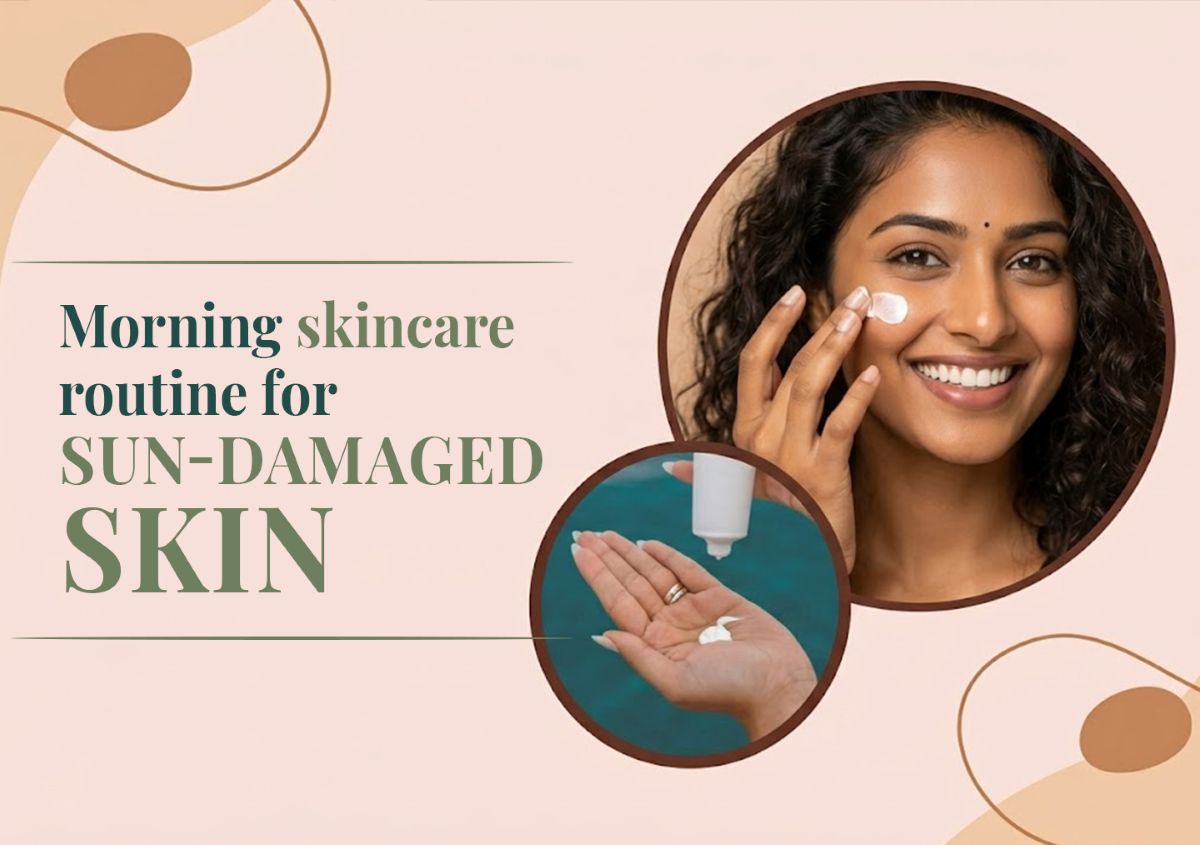
Nobody intentionally damages their skin. In India, the majority of people don’t take sun protection seriously and hence end up damaging their skin. By the time they become serious about sun protection, the damage has already been done. As a result, they end up with uneven pigmentation, textured skin, open pores, fine lines and dullness. We need to understand that sun damage is real, and this is the cumulative, structural kind. This resides in the dermis, altering your melanocyte behaviour and degrading your collagen, which can’t be reversed.
In the article below, we bring you a step-by-step morning skincare repair guide for sun-damaged skin. This guide will walk you through all the steps and ingredients, along with science-backed reasoning.
What Sun Damage Actually Does to Your Skin
Sun damage ruins 4 aspects required to maintain healthy, radiant skin. The worst part is that all four types of damage happen simultaneously, and each requires a different corrective approach.
- Collagen degradation: UV radiation activates collagen-destroying enzymes, matrix metalloproteinases (MMPs). It accelerates collagen breakdown, which is faster than the natural ageing rate. As a result, skin becomes thin and loses its bounce.
- Melanocyte dysregulation: UV exposure stimulates melanocytes, which, as a protective response, produce more melanin. This prolonged response causes hyperpigmentation, uneven patches, and dark spots.
- Barrier disruption: Lipids and proteins in the outer protective barrier of the skin break down due to chronic UV exposure. A compromised skin barrier accelerates transepidermal water loss and increases skin sensitivity. It reduces the skin’s ability to self-repair.
- Oxidative stress accumulation: UV rays generate free radicals to oxidise cellular components including collagen and lipids. When the natural antioxidant reserves are depleted, the rate of damage accumulation exceeds the rate of cellular repair.
To reverse sun damage, it’s important to form a comprehensive repair and protection system.

Step 1: The Right Cleanser — Remove Without Worsening
Sun-damaged skin has a compromised skin barrier. This clearly means your morning cleanser should be gentle. Look for a cleanser that removes surface debris and overnight product residue without raising the skin’s pH or disrupting its lipid layer.
What to use: Gentle, low-pH gel or cream cleanser with amino acid surfactants.
What to avoid: Avoid foaming cleansers that contain sulfates (sodium lauryl sulfate, sodium laureth sulfate), high-alcohol or anything with fragrance. Sun-damaged skin is already irritated, and we surely don’t want to irritate it further.
Step 2: Antioxidant Serum — Your First Line of Defence
This is one of the most important active steps in the morning routine for sun-damaged skin. It works great when applied before SPF — not instead of it, as it doubles the protection. It not only neutralises free radicals but also restricts melanin overproduction. Vitamin C acts as a cofactor for prolyl and lysyl hydroxylase enzymes to support the repair of UV-degraded collagen matrix.
What to use: It’s best to use stabilised Vitamin C serum (L-ascorbic acid 10–20%, or a stable derivative).
What to avoid: Appropriate storage of vitamin C serum is important as it oxidises rapidly. An oxidised formula loses both its antioxidant and brightening benefits. Therefore, store Vitamin C serum in a dark, airtight container away from heat.
Step 3: Collagen-Support Serum — Repair What UV Has Broken
Collagen support serum, when incorporated in a morning skincare regimen, helps to treat pigmentation. It helps accelerate the structural recovery of sun-damaged skin. UV damage occurs at the dermal level, degrading the quality of both collagen and elastin. Recovering degraded collagen requires active biological signalling to rebuild it. Signal peptides are the solution. Layer peptide serum immediately after vitamin C serum gets fully absorbed. Dab into the skin to provide mild mechanical stimulation to the fibroblasts.
What to use: Look for signal peptides like Palmitoyl Pentapeptide-4 (Matrixyl) and Copper peptides (GHK-Cu) to boost collagen synthesis and signal repair mechanisms.
What to avoid: Do not rub the peptide serum on the skin; instead, dab to stimulate mechanical signal.
Step 4: Targeted Treatment — Address Specific Hyperpigmentation
Vitamin C provides antioxidant protection and handles ongoing melanin inhibition. It also treats signs of established hyperpigmentation—uneven patches, dark spots, and melasma-adjacent pigmentation. A targeted brightening treatment is important. This adds as a second mechanism of pigment correction. The best time to apply the target serum is after the peptide serum and before moisturiser.
What to use: Opt for ingredients that treat hyperpigmentation-related skin concerns and revive your skin’s health.
● Niacinamide helps strengthen the skin barrier and reduces inflammation.
● Tranexamic acid helps inhibit the interaction between keratinocytes and melanocytes that UV exposure triggers.
● Arbutin and kojic acid, when used alongside vitamin C, help significantly reduce melanin production.
Step 5: Barrier Moisturiser — Repair and Seal
Sun-damaged skin has a chronically compromised barrier. Skin loses water faster, and is more reactive towards environmental aggressors. It inhibits cell turnover processes that help to clear pigmented cells from the skin’s surface. To keep your skin’s hydration intact, look for moisturisers that contain Ceramides I, III, and VI-II, and hyaluronic acid. This leave-on product will help repair the skin barrier and counter dehydration. Apply moisturiser while your skin is slightly damp.
What to use: Ceramide-containing moisturiser with hyaluronic acid; lightweight gel-cream texture for Indian climate.
What to avoid: Avoid using a heavy, occlusive moisturiser as it traps heat against the skin and stimulates sebum production.
Step 6: Broad-Spectrum SPF — The Ultimate Protection
Sunscreen application is a mandatory step. This step determines whether your regimen is building towards improvement or fighting a losing battle. Keep the points below in mind for sun-damaged skin:
● SPF 50 is the minimum for addressing accumulated UV damage and providing additional protection.
● PA++++ rating addresses both UVA and UVB. It protects your skin from photoaging, collagen degradation, and deep pigmentation.
● Broad-spectrum provides sunscreen protection against both UVA and UVB. Best for skin that is dealing with both photoaging and photopigmentation.
● Reapplication is the key. SPF degrades over time, with exposure to sweat and sebum. Hence, reapplying SPF every two hours prevents further damage.
What to use: Opt for SPF 50, PA++++ and broad-spectrum (UVA + UVB) sunscreen.
What to avoid: Being negligent about SPF can cause more skin damage than it can repair or rebuild.

What to Expect and When
Sun damage correction is not an overnight miracle but rather follows a biological timeline, as with all structural skin changes. Here, “Consistency’ is the key. Take a look at what to expect as time passes.
● Week 1–2: Skin feels cleaner, more hydrated, more comfortable. No change in pigmentation yet.
● Week 4–6: Skin appears visibly bright. As the skin barrier strengthens, texture improves.
● Week 8–12: Measurable reduction in the appearance of dark spots and uneven tone. Improvement in skin firmness begins.
● Month 4–6: Your skin will show significant pigmentation correction. You will also notice visible improvement in skin density and firmness.
The consistent use of morning skincare compounds provides protection and rebuilds collagen.
The Morning Routine Is the Repair Window
Every morning is a choice point for sun-damaged skin. Sun-damaged skin does not need the most expensive routine. It needs an intentional regimen that further requires consistency. Every ingredient you feed your skin takes you a step closer towards improvement. Remember, it’s a cumulative repair process that requires enough time, enough consistency, and sunscreen.