

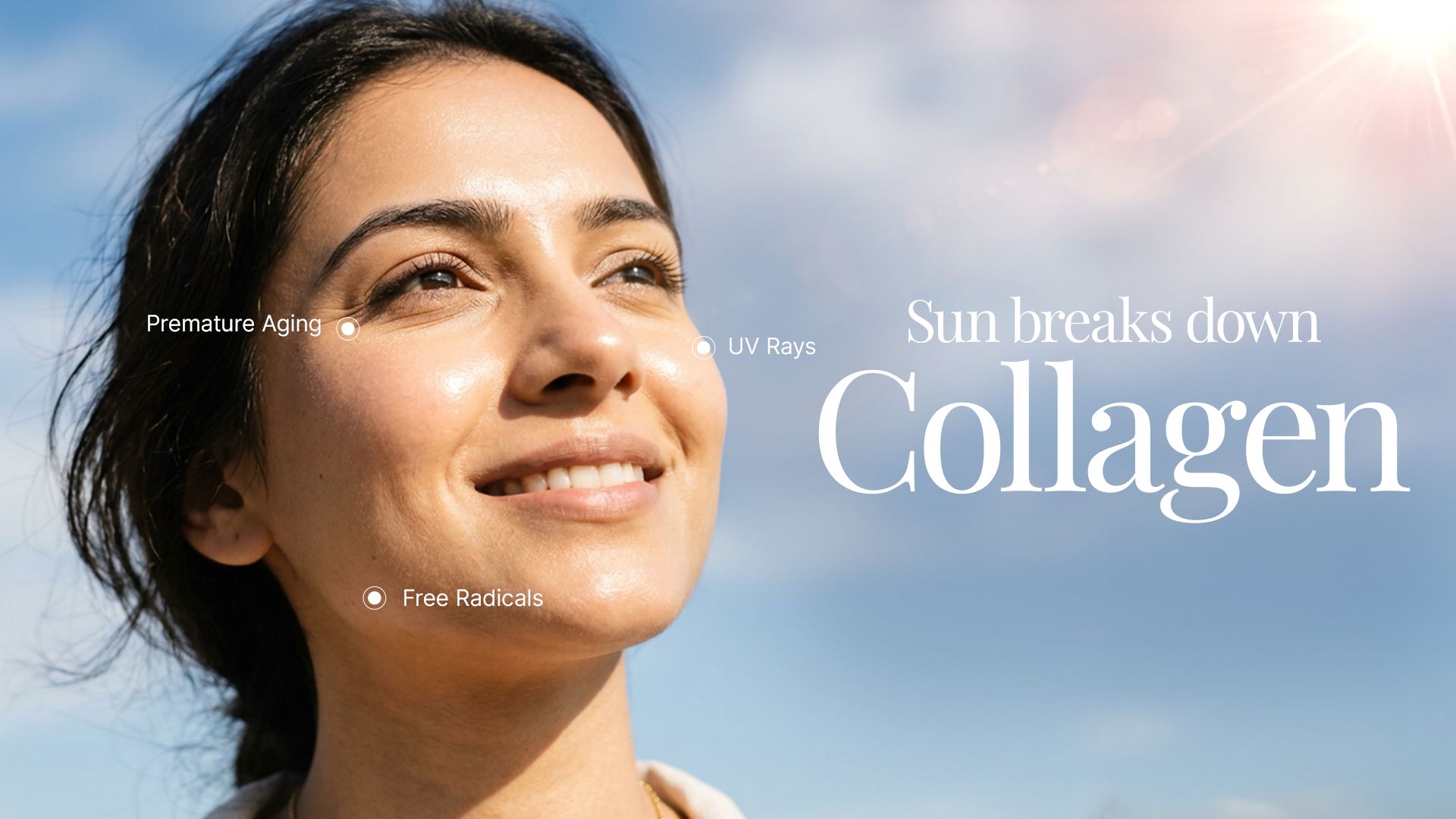
Most people in India knows that the sun exposure ages skin. But only a few understand, why so aggressively skin ages rapidly in India — and only fewer understand the biological clock behind it. India’s geographical position isn’t just bright in India but it also biologically damaging in various ways until years later when you begin to see ageing signs. Skin begin to shows fine lines, hollowed cheeks for sagging of skin due to the collagen breakdown that kept on happening quietly underneath the surface. Keep reading to learn how India’s intense UV radiation silently deteriorate skin’s collagen in – step by step process.
What Is Collagen and What Does It Actually Do?
Before getting into sun damage, let’s understand collagen first and why you need to protect it to prevent ageing. Collagen is a structural protein found in the second layer of the skin. Collagen forms a dense and fibrous network in the deep layer of your skin which helps to keep the skin youthful and radiant. Your body produces collagen naturally, but it begins to decline around the age of 25. Your skin losses roughly 1 to 1.5 percent per year.
Let’s make it simple, collagen acts like mattress spring system: when the springs are well-distributed and intact, your skin appears smooth, firm, and plumped. When the spring system starts to break down, the surface collapses gradually and that’s when you notice the ageing skins on your skin.
Sun exposure in India fasten the natural decline of collagen. UV radiations instantly activates the destructive biological process that breaks down the existing collagen at a faster pace. Not just that it also suppresses the production of new collagen and becomes largely irreversible.
Why India’s UV Environment Is Unusually Aggressive
India sits between 8°N and 37°N latitude that falls in between the Tropic of Cancer and the equator, which means this zone has direct consequences for UV radiations on the skin.
Jot down the points that proves to be responsible for collagen reduction in Indian sun exposure areas:
- High UV Index year-round: By the World Health Organisation, India is classified as “Very High” to “Extreme” as large parts of India records around UV Index levels of 9 to 11+, which is comparatively high from the European countries.
- Long and high intensity daylight hours : Peak UV hours in India that generally falls between 10 AM -4 PM, can last up to 6 hours during summer months that’s when majority of the population are outdoors during these windows.
- UVA penetrates via clouds and glass: Indians believe that they’re safe on cloudy days or when near windows. But they’re not aware that UVA radiation passes through both and therefore responsible for collagen destruction.
- Altitude amplifies radiation: Deccan plateau, Himalayan foothills, and Rajasthan’s desert regions and those Cities and regions at higher altitudes, receive comparatively higher UV radiation that makes skin prone for collage destruction.
The Science: Exactly How Sunlight Destroys Collagen
Let’s dive in deep into the layers of skin to understand where actually the real story happens.
Step 1: UV Rays Penetrates into the Dermis
When UVB rays gets mostly absorbed by the epidermis (the outermost layer) it causes sunburn. But when those rays, penetrate into the second layer of the skin, dermis —where your collagen fibres live that’s where the structural damage begins.
Step 2: Enzymes Gets Activated to Destroy Collagen
As soon as UVA rays reaches the dermis, the production of matrix metalloproteinases (MMPs)— a family of enzymes gets triggered and hampers the break down proteins. This overall fasten the ageing process and also delays collagen production.
Step 3: New Collagen Production Is Suppressed
UV radiation not only destroys existing collagen but it also damages the fibroblasts — the specialised skin cells that help produce new collagen. This repeated hit by UV rays, makes skin loose it self-repair capacity. This dual mechanism caused by the UV radiation is responsible for the most significant environmental cause of collagen depletion.
Step 4: Oxidative Stress Amplifies the Damage
UV radiation produces free radicals by generating reactive oxygen species (ROS). These free radicals attacks the healthy cellular structures, including collagen fibres, which refers to a process known as oxidative stress. Free radical damage is very common in the polluted Indian cities resulting to “urban ageing effect.”
Why Darker Skin Tones Are Not Protected — A Widespread Misconception
This is the major point of discussion which majority of the Indians needs to understand , especially when it comes to sun protection.
Indian skin contains higher concentrations of melanin that naturally provides subtle range of natural SPF roughly— 10 to 15. This mild protection reduces the risk of skin cancer and sunburn when compared to lighter skin tones but is does not protect your skin from collagen breakdown caused by UVA.
Indians with darker skin barely prefer using sunscreen and spend significantly longer time under the sun as compared to the lighter-skinned individuals. Since they don’t observe sun burn their skin miss out the early warning signs like peeling and redness which later results in decades of cumulative collagen loss.
By the time you notice the visible damage—sagging skin, visible fine lines, hollow temples or deep nasolabial folds — your collagen network has already been compromised.
Cumulative Exposure: The Damage You Don’t See Is the Damage That Matters Most
Sun damage to collagen happens silently across years of everyday activities: a short walk, quick scooter commute, that quick grocery visit, that rooftop walk and many more. Ace dermatologists share that cumulative UV exposure is responsible for up to 80 percent of visible skin ageing. And in India where people are ok with high UV exposure and low sunscreen applications plays a major impact.
What does cumulative damage caused by sun appears when it finally surfaces?
- Loss of volume in the mid-face like sunken under-eyes and cheeks
- Collagen depletion results in deepened smile lines and marionette lines in the lower face
- Neck and décolletage wrinkling, those areas that easily gets ignored and unprotected
- Rough, leathery skin texture — the structural depletion caused in the dermis
- Pigmentation, uneven skin tone and dark patches that are caused by melanin dysregulation which gets triggered by chronic UV stress
Practical Sun Protection for the Indian Climate
Knowing the science is only useful if it changes behaviour. Here is what actually works in the Indian context:
- Choose the Right Sunscreen: Pick abroad-spectrum a minimum of SPF 30 and SPF 50 for outdoor exposure. Look for UVA protection rating PA+++ or PA++++ to protect your collagen. Reapplication in two hours should be a ritual.
- Cover Beyond the Face: The collagen loss becomes visible on neck, chest, and hands, the areas where sunscreen application is commonly skipped. Also, opt for physical barriers like hats, full-sleeve cotton clothing for added protection.
- Limit Your Exposure: Make sunscreen application as mandatory skin care step. Avoid stepping out during peak UVA and UVB intensity without protection between 10 AM and 4 PM.
- Add Antioxidants to Your Routine: For topical application, consider adding Vitamin C serum to your skincare regime in the morning as it neutralizes free radicals and supports collagen synthesis. Consider these dietary options for antioxidants— amla, tomatoes, green tea, turmeric and more to keep you internally nourished against oxidative stress.
- Glass, Rain or Clouds Ain’t Shielding: Try to sit away from windows during indoor work and do not forget apply and then reapply sunscreen to keep your skin protected.
Your Skin Is Keeping Score
We need to understand and spread awareness among out people that sun in India is not subtle, rather it is persistent and intense that hamper the collagen in our body. When collagen gets broken down by UV-triggered enzymes and oxidative damage, it loses it regeneration capacity.
Therefore the collagen you protect today is going to provide you younger-looking skin with good structure in your next twenty years. Skin is a responsive tissue that needs the sun protection — Start with sunscreen and make reapplication a habit for healthy skin.
Keywords : Sun damage on skin, Sunlight Destroys Collagen, Protection from sun damage on skin, Sunscreen Benefits, SPF 30, SPF 50