
Introduction: The Changes You Don’t Notice Right Away
Even after knowing so much about collagen, people still rarely think about it until they catch the visible signs. It’s not something you find the next month, when you suddenly realize that collagen is declining.
Rather, it happens silently beneath the skin, and over time, with small changes, it becomes visible. At first, your skin may look fine, but it doesn’t behave the same way and also doesn’t recover that quickly. The skin, once firm and young, loses its natural glow and freshness over time.
The truth is collagen declines earlier than most people expect, but starts quietly in the mid-20s. The drop is slow and barely noticeable. And as the years pass, it becomes more visible. The trickiness is that such changes don’t show up all at once; they appear in subtle ways, which makes it easy to miss the signs until they become more obvious.
It is important to understand the early signals that help in recognizing the skin’s reality. Once you start noticing the signs, you look for immediate fixes, so you need proper support that changes deepen.
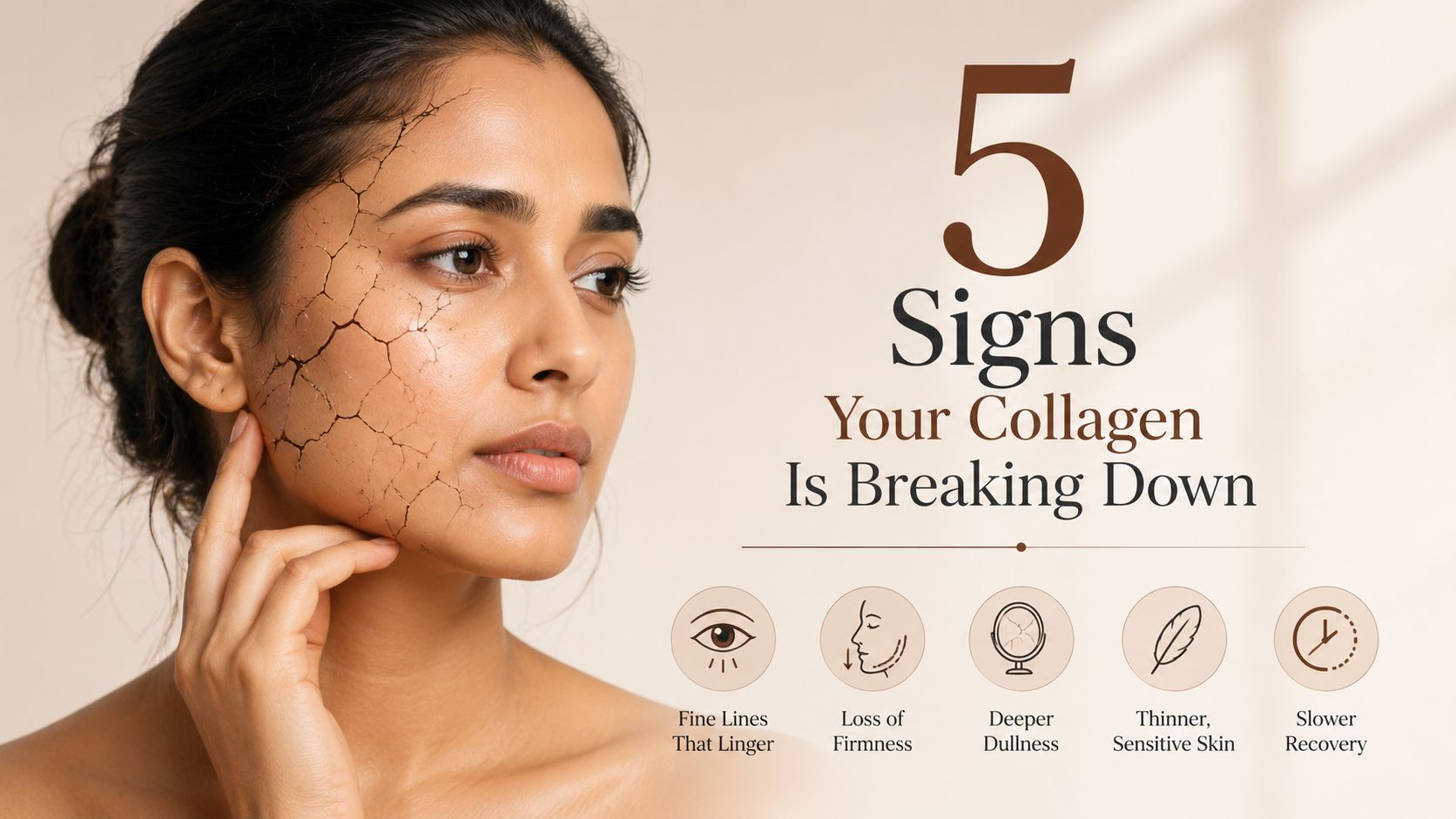
Fine Lines That Stop Disappearing
The earliest signs of collagen breakdown appear as fine lines. When young lines may appear as expression or dehydration, they tend to fade quickly. Like after smiling, frowning, or even after a long day, the skin bounces back to its smoother state. It’s all because collagen provides the structure, which allows skin to recover easily.
Although collagen levels begin to decline in the mid-20s, recovery slows over time. Fine lines start lingering longer than they used to. What was once temporary becomes visible and permanent. The lines begin to settle more firmly around the eyes, mouth, and forehead.
This shift is subtle at first, which is why many people overlook it. They may blame dryness or fatigue, not realizing that the deeper issue is structural. The skin is no longer able to “bounce back” the way it once did.
Loss of Firmness and Natural Lift
Next comes the clear sign of collagen decline: the gradual loss of skin firmness. Once the skin felt tight and supported, not softer in a different way, which is less structured and slightly loose. It is mainly noticed around the cheeks, jawline, and under-eye area.
That may appear as dramatic sagging, but not immediately; it is visible in changes in how the face maintains its actual shape. Sagging and loss of firmness contour appear less defined, and the skin’s natural lift fades over time. This happens because collagen acts like a support system beneath the skin. When that support weakens, the skin no longer holds itself in the same way.
What makes this change tricky is that it feels gradual. You may not notice it day by day, but when you compare photos over time, the difference becomes clearer. The face looks a little less firm, a little less lifted, and a little more tired.
Dullness That Feels Deeper Than the Surface
The dull skin is even blamed on lack of hydration or poor skincare, and the causes are often deeper than usual. Collagen plays an imperative role in maintaining the skin’s thickness and smoothness, ultimately affecting how light reflects off the skin. Low collagen in the skin can make it look flat and less radiant, with a duller, more pronounced effect. It’s not the dryness that can be casually fixed by using moisturizer, but the skin that has lost its inner natural glow. Even when you use brightening products, the results may not feel as effective as they once did.
It’s all because the skin’s structure is changing over time; the decrease in collagen makes the skin less even and less reflective, which makes it look more tired, with a muted appearance and harder to improve with surface-level solutions alone.
Skin Feels Thinner and More Sensitive
Collagen breakdown loosens the skin, making it feel thinner, more delicate, more fragile, and more reactive than before. It’s easy to notice that skin becomes sensitive to products that weren’t that reactive earlier. Redness and itching may appear quickly and take longer to resolve.
Such changes in skin sensitivity are often misunderstood. People believe the skin type may have suddenly changed, but deeper analysis reveals a different picture: weakening of the skin structure.
Collagen provides skin support and resilience; a low level of it makes skin more vulnerable to external factors such as pollution, environmental stress, and harsh ingredients. You may also notice that your skin bruises more easily or takes longer to recover from minor damage. These are all signs that the internal support system is not as strong as it used to be.
Slower Healing and Recovery
That’s one of the most telling signs of collagen decline, in how slowly it recovers. Earlier, the skin may have healed quickly, but now it takes longer to repair itself. The breakouts fade faster, marks disappear sooner, and the skin process feels smoother has changed in recent years. This is all because of decreased collagen with age.
The breakout may leave marks; healing becomes slower. Even small cuts and irritants take longer to heal. In general, these are signs that the skin struggles to return to its original state, which can cause longer-lasting marks and an uneven texture.
This slower recovery is often one of the last signs people connect to collagen loss, even though it is one of the most important indicators of what is happening beneath the surface.
The Final Verdict: Why These Signs Matter?
Maybe at first glance, such signs look small and casual, but once they are permanent, they cannot be reversed. Collagen isn’t all about looking young, but primarily about how the skin functions. It may impact firmness, hydration, repair, and resilience, but when it starts declining, the effects show up in multiple ways, not just wrinkles.
Understanding these signs as early as possible will definitely help you shift the focus. Rather than chasing quick fixes, it’s important to think rationally for long-term skin health. Collagen breakdown isn’t a loud shout; it happens quietly through small changes that are easily ignored.
Although paying attention to your skin early will not impact it badly, from fine lines to loss of firmness to deeper dullness to increased sensitivityr to slower recovery, all are silent killers of collagen levels. Of course, not sudden problems, but a gradual shift that builds over time. Your skin doesn’t need perfection. It needs support. And understanding these signs is the first step toward giving it exactly that.
Keywords : Collagen Breakdown, Signs of Collagen Breakdown, Dullness of skin, Skin Resilience, Changes in Skin in mid-20s