
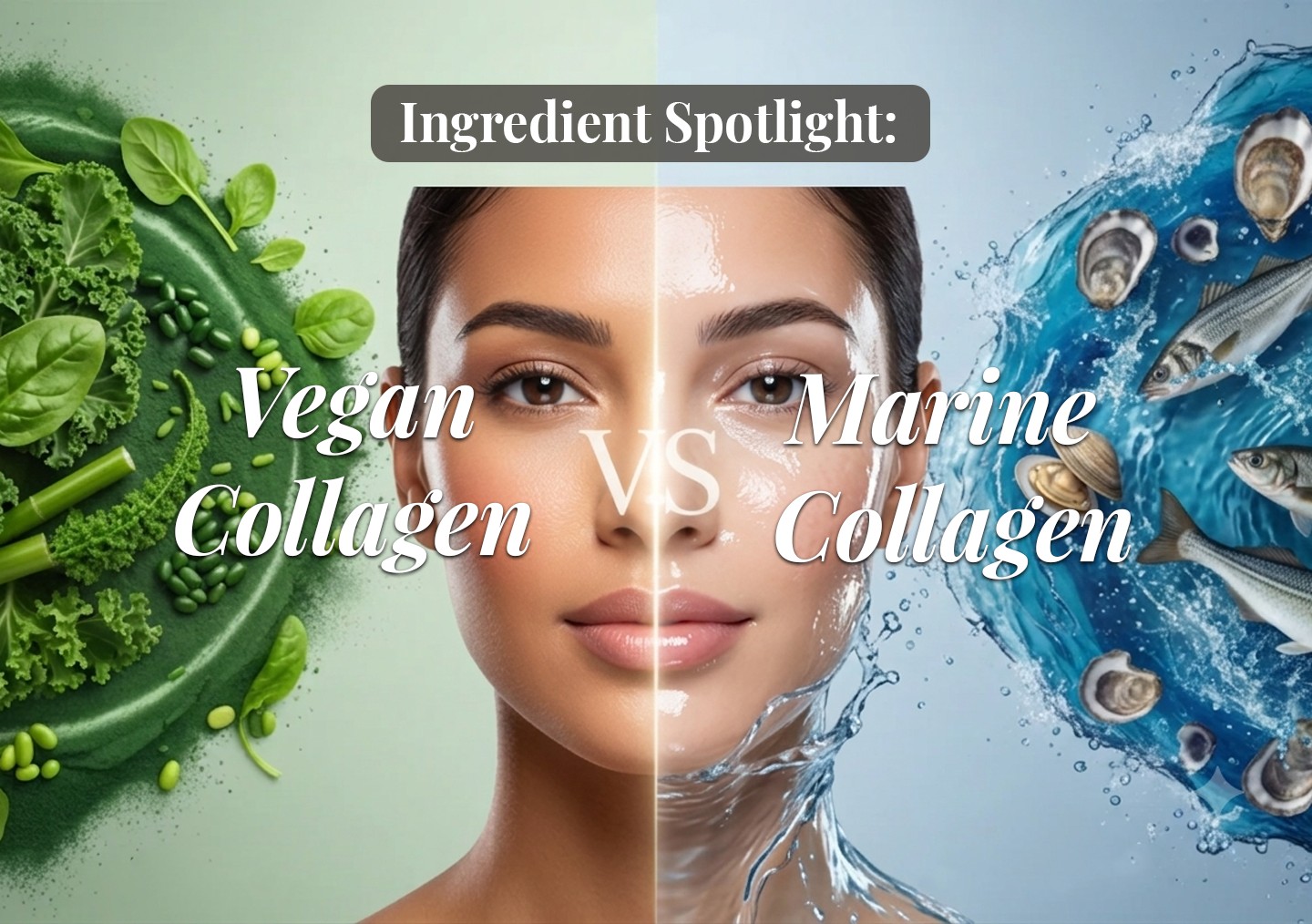
Collagen supplements are all over the internet and widely available in stores. If you are wondering which is better for your skin – “Vegan Collagen” or “Marine Collagen”? Then we’re here to help you. These are two very different types of products wearing the same label. One says “Marine Collagen.” The other says “Vegan Collagen.” Both promise firmer skin, reduced wrinkles and claim to “boost collagen synthesis.” We’re here to break down the silence so that you can decide which one to choose for boosting your collagen synthesis for Indian skin.
The “Collagen Debate” Nobody Is Talking About
None of the marketing will clearly tell you that, fundamentally, marine collagen and vegan collagen do different things. One collagen contains actual collagen protein, while the other contains no collagen whatsoever. The fact is, the distinction between the two types of collagen matters enormously. It’s not because one is superior to the other in some abstract sense, but it’s because they function through entirely different biological mechanisms. And to do this, it is necessary to understand which type of collagen your skin actually needs.
Before we begin, let’s make it clear that it’s not a debate about diet or ethics. It is an awareness conversation about biochemistry, what happens inside your dermis when each of these collagen supplements is introduced. Also, you’ll get to understand which collagen does more to boost collagen production in your skin. Let’s begin!
What Is Marine Collagen?
Marine collagen is a collagen protein that is extracted from the skin, scales, and bones of fish like salmon, cod, tilapia, or snapper. Like all collagens, it is a structural protein that is made up of three amino acids, mainly glycine, proline, and hydroxyproline. These three amino acids form the triple helix structure that gives collagen its extraordinary tensile strength.
How Marine Collagen is Processed as a Skincare Supplement?
What’s interesting about marine collagen is its molecular weight and bioavailability. Marine collagen is broken down into shorter peptide chains, popularly known as hydrolyzed collagen peptides or collagen hydrolysate. These shorter peptide chains get efficiently absorbed through the gut lining (when taken orally) or through the skin barrier (when applied topically). This efficient ability of hydrolyzed marine collagen usually outperforms when it comes to absorption when compared to non-hydrolyzed bovine collagen.
Marine collagen is predominantly Type I collagen, one of the most abundant types in human skin, comprising about 80% of the dermis. This clearly means that marine collagen peptides are consumed and absorbed by the body; they act exactly like the amino acid profile the body uses to rebuild structural proteins.
How marine collagen works in the body:
When hydrolyzed marine collagen peptide supplements are consumed orally, they easily get absorbed into the bloodstream, from which they travel to the dermis to perform two tasks simultaneously:
- They get broken down into individual amino acids that serve as direct raw materials for new collagen synthesis by fibroblasts.
- The peptide fragments act as biological signals. They mimic damaged collagen, triggering a fibroblast repair response that increases collagen production.
This dual mechanism occurs when you consistently consume oral marine collagen. You can witness measurable improvements in dermal collagen density, skin elasticity and hydration after 8–12 weeks of consistent use.
What Is Vegan Collagen?
This is where clarity on collagen supplements becomes essential. “Vegan Collagen” is a marketing term that mostly vegetarian or vegan people prefer to use to boost their skin’s collagen. However, vegan collagen is not the type of collagen our bodies need.
Vegan Collagen is a blend of plant-derived ingredients — vitamin C, Zinc, silica, copper, botanical extracts and amino acids like glycine and proline. The logic behind vegan collagen is that your body makes its own collagen, and the formulation supports the body’s collagen synthesis by filling in any gaps.
The process of collagen synthesis requires specific raw materials and cofactors. So if your diet lacks vitamin C or amino acids, which are the backbone of collagen production. A well-formulated vegan collagen will address those deficiencies and help boost collagen production. But the harsh truth about this vegan collagen is that it cannot replace the collagen protein. Vegan collagen provides only the tools for collagen construction, not the building materials required for collagen synthesis.
Vegan Collagen Booster vs. Marine Collagen
| Factor | Marine Collagen | Vegan Collagen |
| Contains actual collagen | Yes (hydrolyzed peptides) | No |
| Mechanism | Raw material + biological signalling | Cofactor + precursor support |
| Bioavailability | High (especially hydrolyzed) | Dependent on individual deficiencies |
| Type I collagen support | Direct | Indirect |
| Vitamin C content | Typically minimal | Usually included |
| Suitable for vegans | No | Yes |
| Clinical evidence | Extensive | Moderate (for individual ingredients) |
| Best for | Significant collagen loss, ageing skin | Preventive support, dietary gaps |
Vegan collagen contains ingredients like Vitamin C, Zinc, Silica, biotin, Glycine, and proline that are already adequately supplied by your diet. Additional supplementation through a vegan collagen booster will not meaningfully increase collagen production beyond your body’s capacity.
On the other hand, Marine collagen delivers collagen peptides gets absorbed by the body. It later triggers fibroblast activity to provide building materials, which is comparatively higher in ratio than what a balanced diet provides. Hence, you can see visible effects in the overall skin quality and health.
Which Collagen Supplement Is Right for Your Skin?
We’ve listed a few reasons below that’ll help you choose the best collagen supplement your skin actually needs.
Choose marine collagen if:
- You are over 28 and worried about ageing signs and age-related collagen loss
- You have visible signs of reduced skin firmness and deeper lines
- You notice loss of facial definition
- You’re looking for the highest collagen synthesis stimulation with consistent use
- You have no dietary restrictions that revolve around marine-derived ingredients
- You are looking for evidence-backed results within 8–12 weeks
Choose a vegan collagen booster if:
- If you follow a vegan or vegetarian diet
- You are in your early-to-mid 20s and are focused on prevention rather than correction
- You suspect your diet is deficient in vitamin C, zinc, or glycine, which are key collagen cofactors
- You want to combine vegan collagen boosting topically with a broader lifestyle approach to skin health
- You are exploring biosynthetic vegan collagen options
The case for combining both:
Unusual but true! Consider yourself lucky if you can combine both vegan collagen boosters alongside marine collagen. Marine collagen provides the raw material that signals collagen stimulus. A vegan collagen booster provides the enzymatic and cofactor environment your body needs to properly synthesise collagen.
Taking marine collagen without adequate vitamin C (which is fundamental to collagen synthesis) can delay collagen synthesis. That’s the reason why most people drink marine collagen in a smoothie made with citrus fruits to gain the maximum benefits of the collagen supplements — it is how the body is designed to work.

What’s Best for Indian Skin Specifically
Indian skin is exposed to UV radiation, high temperatures, pollution, and other environmental factors that accelerate MMP activity and degrade collagen at a much faster pace. Therefore, Indian skin requires more collagen synthesis than the skin of those living in milder climates. A vegan collagen booster might not keep up with the rate of degradation.
Intake of marine collagen directly stimulates fibroblast activity, and Type I collagen peptides address the collagen deficit more aggressively. Marine collagen addresses the limitation of vegan collagen by providing collagen as a raw material and stimulating fibroblasts.
Topical Application vs. Oral Intake
Marine collagen peptides are too large to penetrate into the skin barrier. But hydrolyzed marine collagens are short-chain peptides (di- and tri-peptides) that can reach the dermis to signal fibroblast activity to deliver the function. Hence, look for “hydrolyzed marine collagen” ingredients in serums and creams to transform your dull skin into a youthful one.
On the other hand, topical vegan collagen booster ingredients — like vitamin C, niacinamide, and plant-derived peptides are well-established in topical skincare. These are among the most evidence-backed actives that support collagen stimulation when applied directly to the skin. Vitamin C serum works as a cofactor of collagen synthesis and does not rely on effective digestive absorption.
To conclude this debate, we believe in both the routes: oral supplementation to internally support systemic collagen synthesis and topical actives to signal fibroblast activity directly in the dermis.
Either Way “The Skin” Wins
In the above article how both these collagen, Vegan collagen boosters and marine collagen are not competing products. In fact, they are different tools designed for distinct jobs.
If you are not under any restriction, then we believe marine collagen should be your first choice. It will effectively reverse or slow visible collagen loss in your skin in just 8-12weeks. But if you’re looking for prevention and have dietary constraints, a high-quality vegan booster, combined with a vitamin C-rich diet and topical peptide, will help you build a complete collagen-support system. That’s why we say- Either way, the skin that wins. Take the best call and let biology lead.
Keyphrases : is marine collagen better than vegan collagen, vegan collagen booster vs marine collagen, how long does marine collagen take to work